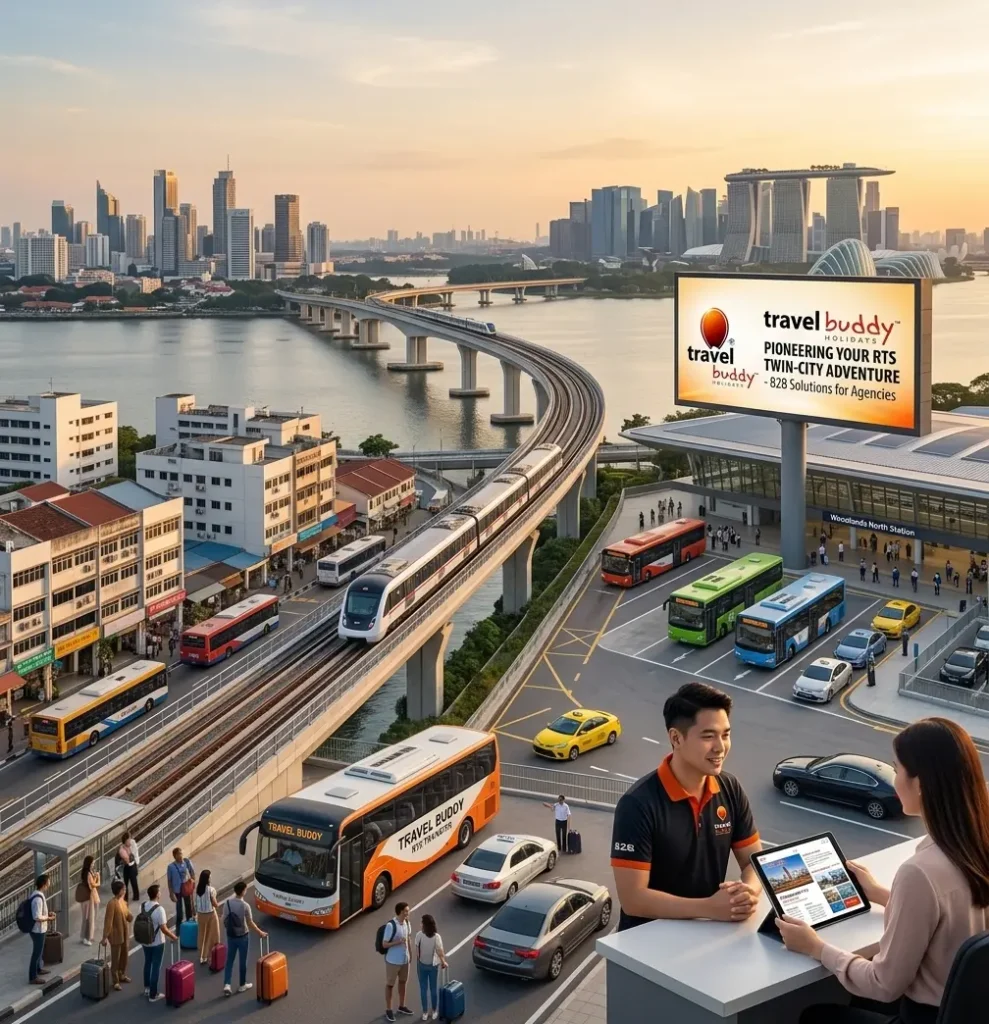
B2B TRAVEL · MALAYSIA + SINGAPORE · CROSS-BORDER TOURISM · RTS LINK
How the Johor Bahru–Singapore RTS Link Could Reshape Twin-City Packages for Travel Agents
The upcoming Johor Bahru–Singapore RTS Link could create a new travel-product opportunity for agencies selling Malaysia and Singapore together. Instead of viewing Johor Bahru simply as a road crossing between two countries, travel agents may increasingly be able to position it as part of a genuine Singapore–Johor twin-city itinerary.
The cross-border railway is designed to connect Woodlands North in Singapore with Bukit Chagar in Johor Bahru in approximately five minutes of train travel. More importantly for tourism planning, Woodlands North connects with Singapore’s Thomson-East Coast Line, while Bukit Chagar brings travellers directly into Johor Bahru.
That does not mean traditional ground transportation will disappear. Hotels, attractions, luggage movements, groups and destinations beyond central Johor Bahru will still require careful coordination. What may change is the way travel agencies structure short extensions, free-and-easy stays and combined Malaysia–Singapore programmes.
RTS Link at a Glance
Cross-border rail connection
Train journey between stations
Peak passengers per hour per direction
Current Singapore target for passenger service
Status note: As of September 2026, Singapore’s Land Transport Authority continues to state that passenger service is targeted to commence at the end of 2026. Agencies should verify the confirmed opening date and operating details before building the RTS Link into bookable itineraries.
Why the RTS Link Matters to Travel Agencies
The RTS Link is frequently discussed as a commuting and congestion project, but its tourism implications are also important.
For travel agents, cross-border friction influences product design. When a transfer feels complicated, agencies tend to package destinations separately or allocate more time simply to moving travellers between them.
A dedicated rail connection between Singapore and central Johor Bahru could make certain types of two-country itinerary easier to understand and market.
The real B2B opportunity is not selling a five-minute train ride. It is designing better travel products around what becomes possible on either side of that train ride.
Woodlands North to Bukit Chagar: What the Connection Actually Does
The RTS Link is a standalone cross-border rail service between two stations: Woodlands North in Singapore and Bukit Chagar in Johor Bahru.
Woodlands North connects directly with Singapore’s Thomson-East Coast Line, creating onward rail access into Singapore’s broader public-transport network.
On the Malaysian side, travellers arrive at Bukit Chagar in Johor Bahru. From there, the itinerary still needs to account for the traveller’s actual hotel, sightseeing programme or onward destination.
This distinction is important. The RTS Link may simplify the border segment, but it does not automatically transport travellers to LEGOLAND Malaysia, Desaru Coast, other parts of Johor or destinations farther north in Malaysia.
| Journey Component | Travel-Agent Consideration |
|---|---|
| Singapore city → Woodlands North | Plan MRT access or private ground transportation according to traveller profile and luggage. |
| Woodlands North → Bukit Chagar | RTS Link cross-border rail segment once commercial passenger service begins. |
| Bukit Chagar → Johor hotel | Determine whether travellers continue independently or require pre-arranged transfer support. |
| Johor Bahru → wider Johor | Road transportation remains important for attractions and destinations outside the immediate station area. |
Co-Located Border Clearance Could Change the Passenger Experience
One of the RTS Link’s most important design features is the use of co-located Customs, Immigration and Quarantine facilities at both Woodlands North and Bukit Chagar.
Under the planned system, passengers will clear the authorities of both countries at the station where they depart. They should therefore not need to complete a second immigration clearance after arriving at the opposite RTS station.
From a tour-design perspective, this matters because border-processing structure directly affects scheduling. However, agencies should still allow appropriate time for passenger processing and should never design an itinerary assuming the five-minute train journey represents the entire door-to-door cross-border travel time.
Opportunity 1: Singapore + Johor Bahru Short Extensions
One of the clearest future product opportunities is a Singapore holiday with a short Johor Bahru extension.
Instead of moving directly from Singapore to Kuala Lumpur, agencies could offer travellers an additional night or two in Johor Bahru depending on the market and customer profile.
Shopping & Leisure
Build free-and-easy time around Johor Bahru’s malls, dining and urban leisure options.
Food-Focused Stops
Use Johor Bahru as another layer in a Malaysia–Singapore culinary journey.
Family Extensions
Connect central Johor Bahru with family attractions elsewhere in Johor through organised ground transfers.
Twin-City Breaks
Position Singapore and Johor Bahru as two contrasting urban experiences within one short holiday.
Opportunity 2: Johor Bahru as a Gateway to Family Travel
Tourism Johor identifies attractions such as LEGOLAND Malaysia Resort among Johor Bahru’s key tourism draws, while Visit Johor 2026 is promoting the wider state’s tourism products to international visitors.
For travel agencies, the RTS Link could make it easier to sell a Singapore-and-Johor family combination conceptually: spend several nights enjoying Singapore’s attractions, cross into Johor Bahru, then continue by road to the family’s next destination.
The important operational point is that Bukit Chagar is only the cross-border rail terminus. Families carrying luggage, travelling with young children or continuing to attractions outside central Johor Bahru may still benefit from private transportation after arrival.
Opportunity 3: Johor Bahru + Desaru Extensions
Another possibility is to use Johor Bahru as the entry point for travellers continuing deeper into Johor.
Tourism Johor has highlighted Desaru Coast as one of the state’s major international tourism products. That creates potential for itineraries that begin with Singapore’s urban experience and then transition into a more relaxed Johor stay.
Example Product Flow
Singapore → Woodlands North → RTS Link → Bukit Chagar → Private Transfer → Desaru
This type of itinerary would use rail for the border crossing while retaining DMC ground transport for the longer Malaysian segment.
It is a good example of why the RTS should be viewed as one component of destination logistics rather than a complete replacement for ground handling.
Opportunity 4: Free-and-Easy Singapore + Johor Packages
The RTS Link may be especially useful for FIT travellers who prefer a semi-independent itinerary.
Agencies could arrange Singapore and Johor accommodation while allowing travellers to use rail for the core cross-border movement, then provide private sightseeing or transfers only where they add real value.
This creates an opportunity for more modular packages rather than relying entirely on coach-based touring.
For the travel agent, the product could combine:
- Singapore hotel accommodation
- Selected Singapore attractions or sightseeing
- Transfer assistance to or from Woodlands North when required
- Johor Bahru hotel accommodation
- Johor sightseeing or private transportation
- Family-attraction transfers
- Onward Malaysia arrangements where required
Opportunity 5: Rethinking the Traditional Malaysia–Singapore Itinerary
Traditional multi-country programmes often concentrate on Kuala Lumpur and Singapore, with Johor treated largely as a transit corridor between them.
The RTS Link and Visit Johor 2026 create an opportunity to reconsider that structure.
Johor does not need to replace Kuala Lumpur. Instead, it can become another product layer for agencies serving travellers who want shorter journeys, family attractions, leisure stays or a more detailed Malaysia–Singapore itinerary.
| Traditional Structure | Possible RTS-Era Variation |
|---|---|
| Singapore → Kuala Lumpur | Singapore → Johor Bahru → Kuala Lumpur |
| Singapore city break | Singapore + Johor Bahru twin-city break |
| Singapore family holiday | Singapore + Johor family-attraction extension |
| Singapore stopover | Singapore + Johor + Desaru programme |
The RTS Link Does Not Eliminate the Need for a DMC
Better public transport can actually make destination management more specialised rather than less relevant.
An agency may no longer need a private vehicle for every kilometre of a Singapore–Johor itinerary, but someone still needs to determine where rail makes sense and where private transportation creates a better passenger experience.
This is particularly important for groups, elderly travellers, families, travellers with significant luggage, corporate movements and passengers continuing beyond Johor Bahru.
Coordinate accommodation on both sides of the border around the wider itinerary.
Connect stations with hotels, attractions and onward destinations.
Decide whether rail or through-ground transport better suits the traveller’s baggage requirements.
Build Johor experiences around the arrival point rather than treating the city purely as a crossing.
Assess whether public rail, private coach or a hybrid model makes operational sense.
Connect Singapore and Johor with Kuala Lumpur or other Malaysian destinations.
Which Client Types Could Suit RTS-Based Packages?
Not every traveller needs an RTS-based itinerary. The strongest use cases are likely to be those where the rail connection genuinely improves the travel flow.
FIT travellers may appreciate the flexibility of moving between cities independently. Couples and friends may be interested in a short Johor Bahru extension. Families could use Johor Bahru as a gateway to family attractions, while repeat Singapore visitors may welcome an easy way to add a second destination.
Large groups require more careful evaluation. Moving dozens of passengers and their luggage through rail stations may not always be preferable to a coordinated coach programme, even when the train journey itself is fast.
What Travel Agents Should Do Before Selling RTS Packages
Because passenger service has not yet commenced as of September 2026, agencies should avoid building fixed operational promises around unconfirmed details.
- Wait for the confirmed commencement date.
- Check the final operating hours and service frequency.
- Confirm ticketing and fare arrangements once formally published.
- Allow realistic station-processing time in addition to the train journey.
- Assess luggage requirements before recommending rail.
- Arrange last-mile transport where the traveller’s hotel or attraction is not near the station.
- Maintain alternative cross-border transport plans when operationally appropriate.
Visit Johor 2026 Adds Another Reason to Develop the Product Now
The timing of the RTS Link also intersects with Visit Johor 2026, which is promoting the state as an international tourism destination and highlighting the different travel experiences available across Johor’s districts.
Tourism Johor has specifically highlighted attractions and destinations including LEGOLAND Malaysia Resort, Desaru Coast and the islands and marine recreation of Mersing as part of the state’s broader tourism appeal.
For travel agencies, this means the opportunity is bigger than Johor Bahru alone. The city can become a gateway from Singapore into a wider Johor programme — provided the onward ground logistics are designed properly.
Build Malaysia–Singapore Programmes with Travel Buddy Holidays
Travel Buddy Holidays supports B2B travel agencies and tour operators with destination management and cross-border travel arrangements across Malaysia and Singapore.
Depending on the itinerary, travel support can include accommodation, transportation, transfers, sightseeing and customised programmes for FIT travellers, families, groups and corporate clients.
As new transport infrastructure changes the way travellers move between Singapore and Johor, travel agencies can also explore hybrid programmes that combine public transport connectivity with professional ground arrangements where needed.
A New Cross-Border Rail Link Can Create New Travel Products
The biggest tourism impact of the Johor Bahru–Singapore RTS Link may not be the five-minute rail journey itself. It may be the change in how travellers perceive the distance between the two destinations.
When cross-border movement becomes easier to understand, Johor Bahru can become more visible as an extension of a Singapore itinerary rather than simply a point travellers pass through on the way elsewhere.
For travel agencies, this creates room for new twin-city breaks, family extensions, free-and-easy programmes and wider Johor itineraries.
The agencies that benefit most will be those that treat the RTS Link as a new piece of travel infrastructure around which better products can be designed — while continuing to use professional ground handling wherever the passenger journey requires it.
Frequently Asked Questions
What is the Johor Bahru–Singapore RTS Link?
The RTS Link is a cross-border rail system connecting Woodlands North in Singapore with Bukit Chagar in Johor Bahru, Malaysia. The rail journey between the two stations is designed to take about five minutes.
When will the Johor Bahru–Singapore RTS Link open?
Singapore’s Land Transport Authority currently states that the RTS Link is targeted to commence passenger service at the end of 2026. Travel agencies should confirm the final opening date before including it as a fixed component of client itineraries.
Which stations will the RTS Link connect?
The RTS Link will connect Woodlands North in Singapore with Bukit Chagar in Johor Bahru. Woodlands North also connects with Singapore’s Thomson-East Coast Line.
Will passengers clear border controls twice on the RTS Link?
The planned co-located Customs, Immigration and Quarantine system means passengers will clear both countries’ authorities at their departure station and should not need to repeat immigration clearance at the arrival station.
Can travel agents create Singapore and Johor Bahru twin-city packages?
Yes. Once passenger operations begin, the RTS Link could support Singapore–Johor Bahru itineraries combining accommodation, sightseeing and onward Johor experiences, provided transfer and luggage requirements are planned appropriately.
Does the RTS Link replace private ground transportation?
Not necessarily. Private ground transportation may still be useful for hotels, attractions, groups, passengers with significant luggage and onward journeys to destinations outside central Johor Bahru.
Can Travel Buddy Holidays support Malaysia–Singapore cross-border programmes?
Yes. Travel Buddy Holidays provides B2B destination management support across Malaysia and Singapore, including accommodation, transportation, sightseeing and customised cross-border programmes for travel agencies and tour operators.
Start Building the Next Generation of Malaysia–Singapore Itineraries
Explore how Singapore, Johor Bahru and wider Malaysia can work together in customised FIT, family, group and cross-border programmes for your travel agency.