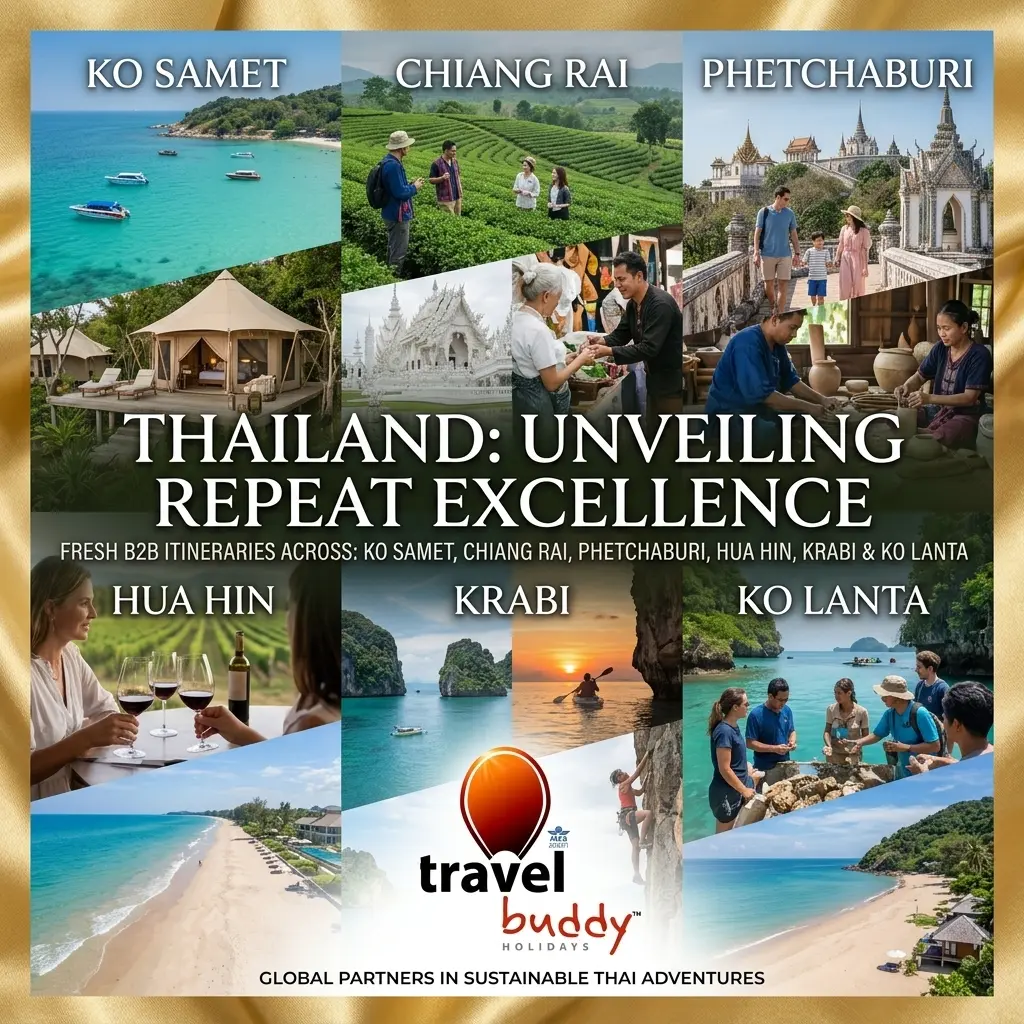
B2B TRAVEL · THAILAND PRODUCT DEVELOPMENT · REPEAT VISITORS · 2026
Thailand Repeat-Visitor Itineraries for Travel Agents: 4 Routes Beyond Bangkok, Pattaya & Phuket
Thailand repeat-visitor itineraries for travel agents need a different product strategy from first-time holidays. Clients who have already experienced Bangkok, Pattaya, Phuket or the country’s best-known sightseeing circuits may not be looking for another variation of the same temples, shopping malls and island excursions.
The opportunity for travel agencies is to sell Thailand again by changing the reason for travelling. Wellness, local food, creativity, farm experiences, mangroves, secondary cities and slower island stays can create an entirely different holiday without requiring the traveller to choose another country.
A useful new product framework appeared in September 2026 when the Tourism Authority of Thailand introduced four themed journeys covering Rayong and Ko Samet, Chiang Rai, Phetchaburi and Hua Hin, and Krabi with Ko Lanta. Although developed for a current Chinese-market familiarisation campaign, the routes provide strong ideas for agencies serving repeat clients from many source markets.
What Changed on 28 September 2026?
TAT published four new themed journeys under its current “Healing is the New Luxury” positioning. The programmes were being experienced by 31 Chinese KOLs from 26–29 September as part of the Amazing Thailand Mid-Autumn Celebration and Nihao Month campaign.
Rather than concentrating on Thailand’s standard introductory circuit, the journeys combine wellbeing, food, local lifestyles, culture, creativity, nature and soft adventure.
For overseas travel agencies, the useful lesson is product diversification: Thailand can be repackaged around a traveller’s interests instead of simply changing the hotel within an itinerary they have already experienced.
Why Repeat Visitors Need a Different Thailand Product
A first-time visitor often wants recognisable landmarks and destinations. A returning traveller may already have photographs of Bangkok’s temples, nights in Pattaya, a Phuket beach stay and a standard island excursion.
Selling the destination again therefore requires a new layer of value.
That could mean travelling more slowly, entering a secondary destination, focusing on food or wellness, staying on a farm, learning a local craft or choosing an island because of its atmosphere rather than because it appears in every introductory Thailand brochure.
For repeat clients, the destination may be familiar. The experience should not be.
Route 1: Rayong + Ko Samet for Active Wellness and a Slower Island Stay
TAT calls its first new journey “Blue Healing.” The concept begins with active wellness experiences in Rayong before moving to Ko Samet for a noticeably slower rhythm.
On the island, the emphasis shifts towards beach relaxation, massage and sunset dining. The programme then returns to mainland Rayong for market and local exploration.
This structure is particularly useful for agents whose clients have already visited Pattaya or Phuket and want another coastal Thailand experience without repeating the same holiday format.
Rayong
Use the mainland for local food, markets, wellness and experiences beyond the beach.
Ko Samet
Shift the itinerary towards beach time, massage, sunset experiences and a less intensive schedule.
Best Product Logic
City or active experiences first, followed by a slower island finish.
Official Tourism Thailand information also positions Ko Samet around beaches, island experiences, massage and leisure, while Rayong’s local food traditions provide an additional product layer on the mainland.
Who Could This Route Suit?
Couples, wellness travellers, small FIT groups and clients wanting a short beach extension without returning to Phuket are natural audiences.
It can also work as a second-visit Thailand programme combined with Bangkok, provided the itinerary gives Rayong enough identity of its own rather than treating it purely as the transfer point for Ko Samet.
Route 2: Chiang Rai for Creativity, Lanna Culture and Farm Experiences
The second TAT journey, “Rainbow Retreat,” focuses entirely on Chiang Rai and demonstrates how agencies can sell northern Thailand without automatically rebuilding another Chiang Mai itinerary.
The programme includes Wat Rong Khun, Wat Rong Suea Ten, Northern Thai cuisine, Chiang Rai’s Saturday night market, an organic farm stay and workshops involving natural dye, herbs and tea. Traditional Lanna crafts and the Black House Museum add another creative dimension.
This mixture is commercially useful because it gives agencies several ways to position the same destination.
Chiang Rai Product Themes
Culture: temples, Lanna heritage and art.
Creativity: workshops, crafts and contemporary design.
Food: Northern Thai cuisine and local markets.
Nature: mountain scenery, farms and tea landscapes.
Slow travel: farm stays and experiences that require participation rather than quick sightseeing.
Tourism Thailand’s current Chiang Rai destination information reinforces this diversity, highlighting Wat Rong Khun, Wat Rong Suea Ten, Baan Dam Museum, mountain landscapes and Lanna culture.
Why Chiang Rai Works for a Repeat Thailand Client
Chiang Rai feels different from the country’s major beach and metropolitan destinations. It can therefore provide the sense of discovering “another Thailand” without requiring the client to leave the country they already enjoy.
For agents selling experiential travel, the workshops and farm components are particularly valuable because the itinerary becomes participatory rather than purely observational.
Route 3: Phetchaburi + Hua Hin for Food Heritage and Seaside Wellness
TAT’s “Amber Gastronomy” route links Phetchaburi with Hua Hin through local food traditions, lifestyle, wellness and leisure.
The Phetchaburi section explores the province’s sea-salt traditions, toddy-palm culture and local cuisine before the journey continues towards Hua Hin.
In Hua Hin, the concept moves towards creative markets, rail travel, wellness, spa experiences and seaside dining.
That contrast gives agencies an opportunity to build a programme where gastronomy is not simply a restaurant reservation but the thread connecting two destinations.
| Destination | Product Focus |
|---|---|
| Phetchaburi | Sea salt, toddy palm, local food heritage and regional lifestyle. |
| Hua Hin | Creative markets, seaside dining, spa, wellness and leisure. |
Who Could This Route Suit?
Food-focused travellers, couples, mature travellers, small private groups and clients who want a slower alternative to the country’s more intensive beach-resort destinations.
It also works for agents trying to add depth to a Bangkok holiday: instead of flying immediately to a southern island, the programme can continue towards Phetchaburi and Hua Hin using the journey itself as part of the experience.
Route 4: Krabi + Ko Lanta for Soft Adventure, Nature and Wellness
Krabi is already familiar to many travel agencies, which makes TAT’s fourth concept particularly interesting.
The “Green Rediscover” journey does not position Krabi simply around conventional island hopping. Instead, it combines soft adventure, nature, wellness and more premium experiential travel before extending towards Ko Lanta.
Activities in the September 2026 familiarisation itinerary include kayaking at Khlong Nam Sai, Wat Tham Suea, a premium long-tail boat experience, rainforest activities, Thai cooking and a sunrise visit to Thung Yee Pheng Mangrove Forest combined with Thai massage.
B2B planning note: The activities above describe TAT’s specific September 2026 familiarisation programme. Agencies should confirm which components are regularly bookable and operational for the client’s actual travel dates before including them in a quotation.
This distinction matters because a repeat visitor who has already taken a standard Krabi four-island excursion may still have considerable unexplored product available in the same province.
Rediscovering a Familiar Destination Can Be Easier Than Selling a New One
Travel agencies do not always need to persuade a returning client to visit an unfamiliar region. Sometimes the stronger approach is to show that a familiar destination contains experiences they missed the first time.
Krabi can therefore be repositioned from “island-hopping destination” to a combination of kayaking, rainforest, mangroves, cooking, wellness and Ko Lanta.
Which Route Fits Which Repeat Traveller?
| Route | Core Interest | Useful Client Segment |
|---|---|---|
| Rayong + Ko Samet | Wellness + beach | Couples, wellness FITs, short island extensions |
| Chiang Rai | Culture + creativity | Experiential travellers, culture clients, small private groups |
| Phetchaburi + Hua Hin | Food + lifestyle + wellness | Food travellers, couples, mature travellers |
| Krabi + Ko Lanta | Nature + soft adventure | Active couples, premium FITs, repeat beach travellers |
Do Not Sell Repeat Visitors the Same Number of Destinations
A common mistake is assuming that an experienced Thailand traveller wants to see even more places in even fewer days.
Repeat travel can work better in the opposite direction.
A client who rushed through Bangkok, Chiang Mai and Phuket on the first trip may now appreciate five nights split between only Rayong and Ko Samet or several days exploring Chiang Rai properly.
Fewer hotel changes also create more space for workshops, markets, wellness, cooking and community experiences that cannot be squeezed comfortably between constant transfers.
First-time Thailand often sells breadth. Repeat Thailand can sell depth.
Build Products Around Interests, Not Only Destinations
Another useful strategy is to organise repeat-visitor packages by theme.
Instead of advertising “6 Days Thailand,” an agency can develop products such as a Thailand Wellness Escape, Northern Creativity Journey, Thai Food Heritage Route or Southern Nature and Mangrove Journey.
This changes the customer’s buying decision. They are no longer comparing the programme directly with the first Thailand package they purchased several years earlier.
The itinerary has a different purpose from the beginning.
Keep Bangkok as a Gateway Without Making It the Main Product
Repeat clients do not necessarily need to avoid Bangkok completely.
The city can still work as an arrival point, a one-night stop, a shopping finish or the connection into another region. The difference is that Bangkok no longer needs to consume three or four nights of every Thailand itinerary.
For example, an agency could build:
- Bangkok + Rayong + Ko Samet for city, wellness and island relaxation.
- Bangkok + Chiang Rai for city time followed by creativity, culture and northern landscapes.
- Bangkok + Phetchaburi + Hua Hin for food heritage and seaside wellness.
- Bangkok + Krabi + Ko Lanta for clients who want the south but need a more experiential programme than their first beach trip.
What Travel Agents Should Ask a Repeat Thailand Client
The easiest way to avoid duplicating a previous holiday is to begin the enquiry differently.
- Which Thailand destinations have you already visited?
- Which experience from your previous trip did you enjoy most?
- What would you prefer not to repeat?
- Do you want more nature, food, wellness, culture or beach time?
- Would you prefer fewer destinations and longer stays?
- Are hands-on activities such as cooking, crafts or farm experiences appealing?
- Would you revisit a familiar region if the experience were completely different?
The answers provide a much stronger product brief than simply asking how many days the customer has available.
Why a Local DMC Matters More for Secondary-Destination Products
Standard Thailand itineraries are relatively easy for international agencies to recognise. Secondary-destination programmes require more detailed operational planning.
Farm stays, workshops, markets, local guides, island connections, private transfers and small-scale experiences may operate differently from mainstream attractions.
A destination partner can help determine which components are appropriate for FIT travellers, private groups or series business and identify where transport or timing needs to be adjusted.
It is also important to distinguish an inspirational campaign itinerary from a fully contracted travel package. Not every experience used in a media or KOL familiarisation journey should automatically be promised to retail clients without confirming availability.
Develop Fresh Thailand Products with Travel Buddy Holidays
Travel Buddy Holidays works with international travel agencies and tour operators requiring customised Thailand programmes and destination management support.
Instead of repeating a standard Bangkok–Pattaya–Phuket itinerary, agencies can brief the destination team on the client’s previous Thailand travel history, interests, preferred pace and required hotel or transport arrangements.
Ground support can include customised itineraries, accommodation, airport transfers, intercity transportation, sightseeing and operational coordination for FITs and groups.
Thailand’s Repeat-Visitor Opportunity Is Bigger Than Another Beach
Selling Thailand for a second or third visit does not require finding an unknown island every time.
The stronger strategy is to change the experience.
Rayong and Ko Samet can turn a beach holiday into a wellness journey. Chiang Rai can shift the focus towards creativity and Lanna culture. Phetchaburi and Hua Hin can become a food-and-wellness route. Krabi and Ko Lanta can move beyond conventional island hopping into mangroves, cooking and soft adventure.
For travel agencies, that creates an important product-development advantage: Thailand can remain in the portfolio for existing customers without the next itinerary looking like a copy of the first.
Frequently Asked Questions
What Thailand destinations can travel agents sell to repeat visitors?
Repeat visitors can explore combinations such as Rayong and Ko Samet, Chiang Rai, Phetchaburi with Hua Hin, or Krabi with Ko Lanta depending on whether their interests focus on wellness, culture, food, nature or soft adventure.
Is Ko Samet suitable for travellers who have already visited Phuket?
Ko Samet can provide a different coastal experience when combined with Rayong, local exploration and wellness rather than attempting to recreate a Phuket-style resort and excursion programme.
Why is Chiang Rai useful for repeat Thailand itineraries?
Chiang Rai combines Lanna culture, distinctive temples, art, local markets, mountain landscapes, farms and creative activities, giving agencies a northern product that can feel very different from a standard first-time Thailand itinerary.
Can Phetchaburi and Hua Hin be combined in one itinerary?
Yes. The destinations can be linked around food heritage, local lifestyles, wellness and seaside leisure, creating a slower travel product rather than treating Hua Hin only as a beach stay.
How can travel agents make Krabi different for a repeat visitor?
Instead of relying only on standard island excursions, agencies can explore suitable experiences involving kayaking, cooking, mangroves, rainforest, wellness and a Ko Lanta extension, subject to current availability and operating conditions.
Should repeat Thailand visitors spend longer in fewer destinations?
Often this works well because longer stays create time for workshops, local food, wellness and community experiences that are difficult to include in a fast multi-city itinerary. The right pace still depends on the individual traveller.
Can Travel Buddy Holidays build customised Thailand itineraries for travel agents?
Travel Buddy Holidays provides B2B Thailand destination management support and customised programmes for international travel agencies, including accommodation, transfers, transportation, sightseeing and itinerary planning for FITs and groups.
Give Your Repeat Thailand Clients Something New to Sell
Share your client’s previous Thailand itinerary, interests and preferred travel style with Travel Buddy Holidays to develop a fresh second- or third-visit programme.